Rolling out an ERP in a Tunisian small business: 6 steps, 6 challenges
No org chart, no IT counterpart, a culture of trust that blocks every control: the six steps of an ERP rollout in a micro-business, and the challenge that comes with each one.
ERP methodologies were written for organisations that already have an org chart, an IT department, written procedures and a control function. The Tunisian micro-business usually has none of that.
That is not a flaw. It is an implicit organisation, built around the owner, the client relationship and production. The integrator’s real job is not to replace it with a textbook organisation: it is to make it explicit without breaking it.
Here are the six steps we follow, and the challenge that comes with each one.
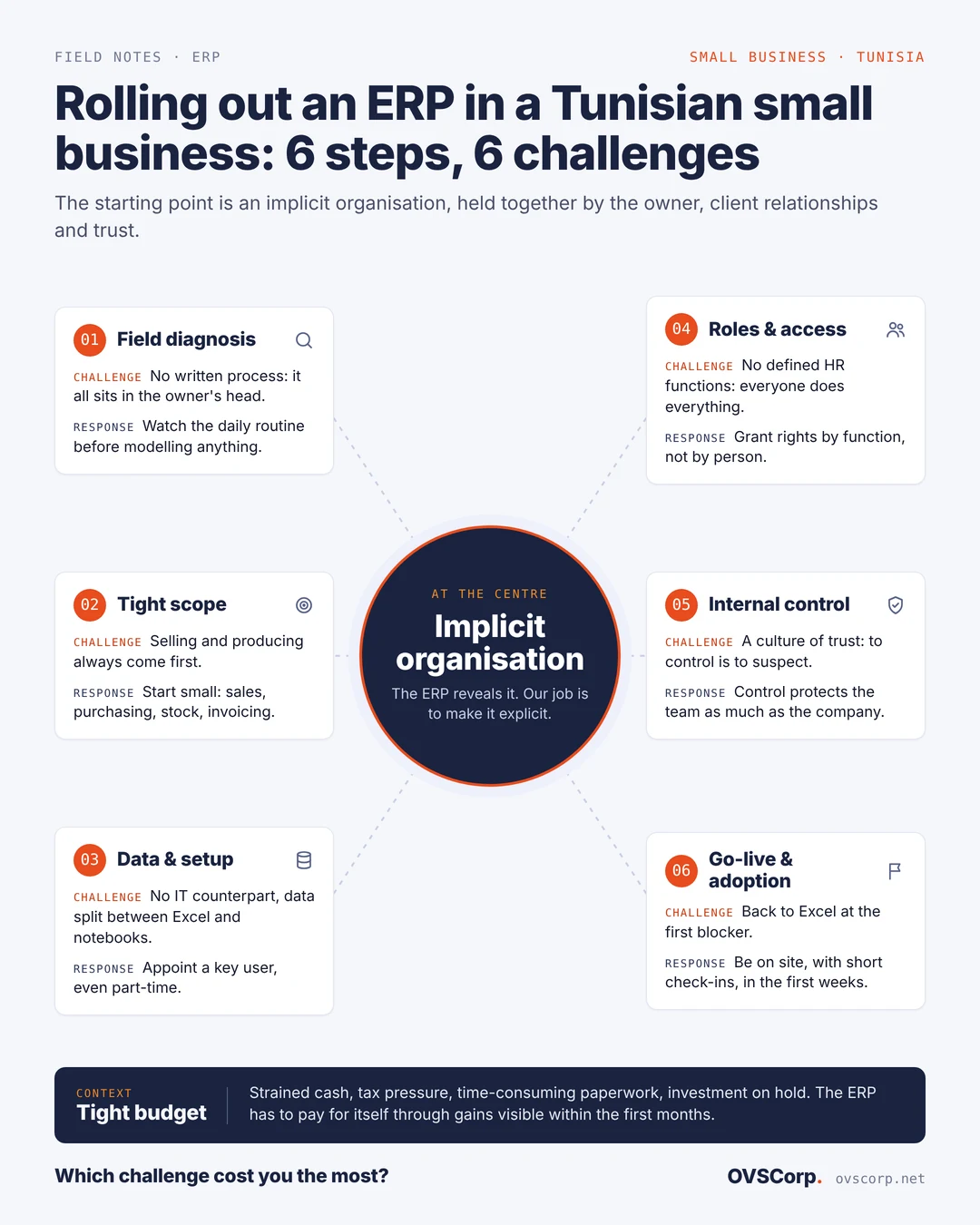
The context: a budget under pressure
Before any discussion of method, look at the financial reality. The Tunisian small business operates with strained cash, client payment terms that keep stretching, and tax pressure that hits cash directly: advance payments, withholding tax, VAT to remit. On top of that sits paperwork that eats the owner’s time. In an investment climate that is hard to read, every non-productive expense is postponed, and an ERP is usually filed under that heading.
This changes how the project has to be run. An ERP cannot be sold as a structural investment with a distant payback. It has to pay for itself through gains visible within the first months: better collection tracking, tighter stock, faster return preparation. That is also what justifies a phased start, an open-source core such as Odoo Community, and subscription hosting rather than a heavy upfront investment.
1. Field diagnosis
In a micro-business, processes are not written down: they live in the owner’s head and in those of two or three key people. A standard scoping workshop produces only the idealised version — the one told to a visitor.
We spend time on site, watching how an order is actually taken, prepared, invoiced and collected, before modelling anything. This is the phase where you find the cash book kept in parallel, the storekeeper’s spreadsheet, and the discounts granted over the phone with no written trace.
Challenge: no written process, it all sits in the owner’s head. Response: watch the daily routine before modelling anything.
2. Tight scope
Selling and producing come first, always. The ERP project ranks behind tomorrow’s delivery, and rightly so: that delivery pays the wages. An ambitious perimeter turns into postponed workshops, approvals that drag, and a project that stalls.
So the starting perimeter has to be small and useful within the first week: sales, purchasing, stock, invoicing, with the Tunisian tax layer. That is the typical scope of our fixed-price Odoo implementations in Tunisia. The rest comes once the tool has proved its value — in other words, once it has started paying for itself.
Challenge: selling and producing always come first. Response: start small, on a perimeter that is immediately useful.
3. Data and setup
There is no IT counterpart. Items, customers, suppliers and prices sit across spreadsheets, notebooks and people’s memories. Duplicates are everywhere, references are inconsistent, customer balances are approximate.
Without an internal owner, the project depends entirely on the integrator — including for deciding what is correct and what is not. We always ask for a key user, even part-time, who validates the migrated data and becomes the internal relay after go-live. It is the single decision that changes the outcome most, and it costs nothing.
Challenge: no IT counterpart, data split between spreadsheets and notebooks. Response: appoint a key user, even part-time.
4. Roles and access
With no defined HR functions, the same person sells, takes payment, releases stock and sometimes records purchases. Mapping access rights onto people freezes that confusion inside the software and makes every change painful: one departure, one new hire, and it all has to be redone.
We define rights by function — sales, cash, warehouse, accounting — then assign functions to people. One person may hold several, which is normal in a small business. But the overlap becomes visible, and therefore open to discussion, and the organisation can evolve without a full re-setup.
Challenge: no defined HR functions, everyone does everything. Response: grant rights by function, not by person.
5. Internal control
This is the hardest point. In a culture of trust, introducing a validation step, a segregation of duties or a reconciliation is often read as suspicion — by the owner as much as by the team. The objection always takes the same form: “here, we know each other.”
The framing changes everything. Control protects the honest employee as much as the company, because it makes it possible to prove that the discrepancy did not come from them. A rolling stock count, a discount threshold to approve, a till reconciled every evening are not signs of distrust: they are what stops a doubt from settling on someone, one day, with no way to clear it.
Challenge: a culture of trust, where to control is to suspect. Response: present control as protection for the team.
6. Go-live and adoption
At the first blocker, the pull back to spreadsheets is immediate. It is all the stronger because the old way did work — badly, but it worked, and everyone knew how to use it.
The first weeks decide the outcome: presence on site, short and regular check-ins, fast fixes. A missing report fixed in two days keeps confidence; the same report fixed in three weeks brings the spreadsheet back. An ERP abandoned after a month costs more than one never installed, because it leaves behind a team convinced that “it doesn’t work here.”
Challenge: back to spreadsheets at the first blocker. Response: be on site, with short check-ins, in the first weeks.
What we take from this
An ERP does not structure a small business. It reveals its implicit organisation, strengths and grey areas included. The strengths deserve to be kept: responsiveness, closeness to the client, the ability to decide fast. The grey areas need to be named, then handled one at a time, at a pace the business can absorb.
So the integrator’s job is not only technical. It is walking the owner from the implicit to the explicit, accepting that the walk takes time and energy, and making sure each step produces a visible gain before the next one is asked for.
Considering an ERP project in a business like this? Tell us about your activity and we will come back with a first scoping and the modules that matter.